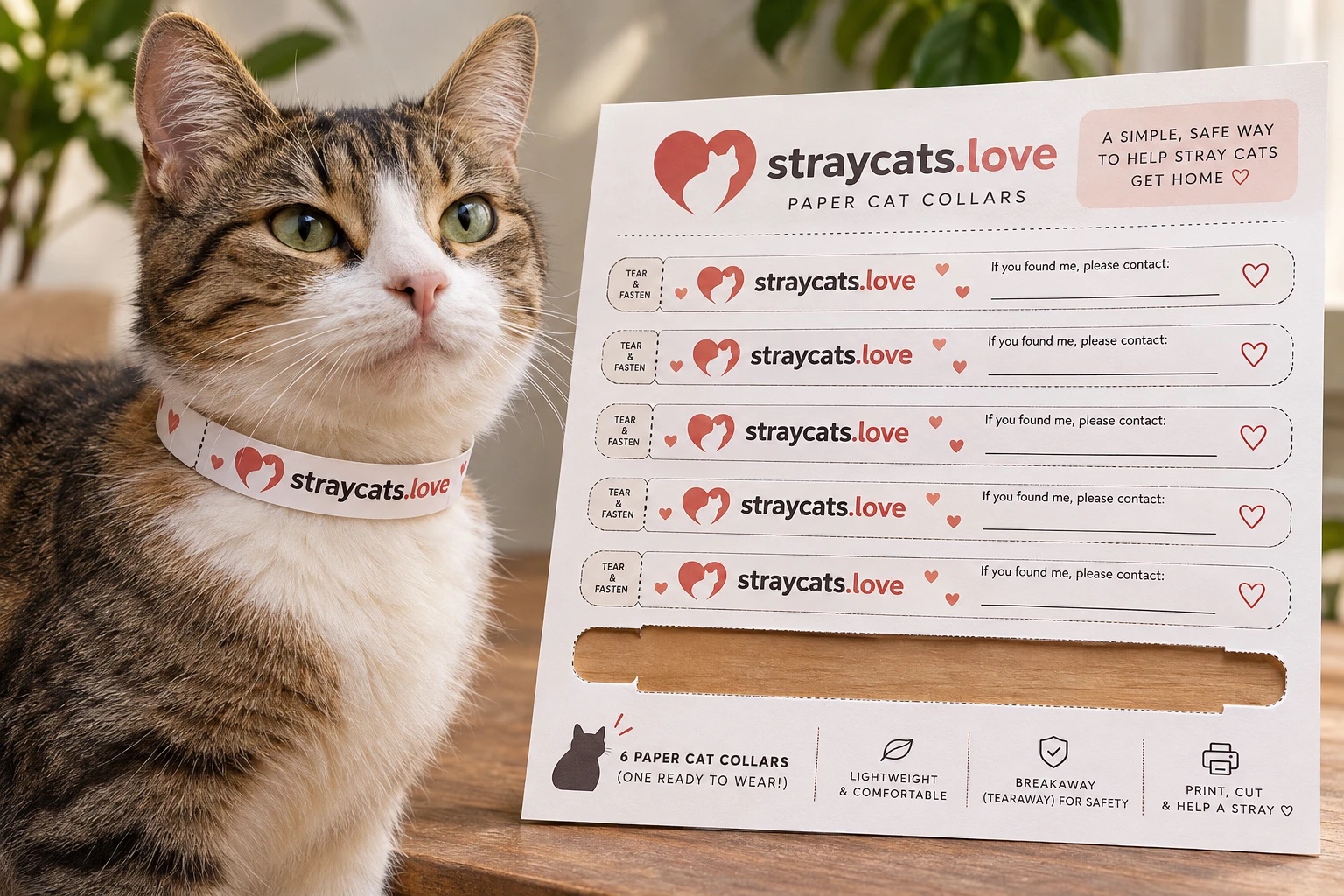
An idea for a simple, cheap way to ask a friendly cat’s owner to get in touch.
I first saw the paper collar in a post by a moderator in the Facebook group Table View Pets lost & found, in Cape Town, on 23 July 2025. I thought it was a new idea. It isn’t.
What a paper collar is
It is a strip of paper, worn loosely around the neck of a friendly cat who keeps turning up, that asks one question: “Is this cat yours?” It also gives the finder’s contact details. If the cat has an owner who has been searching, the owner can see the strip and get in touch.
Not a new idea
Plenty of organizations already publish free printable versions, including Cats Protection and Wood Green in the UK, International Cat Care, Austin Animal Services, and others, such as Ottawa Humane Society, Regina Humane Society and Animal Register NZ. A thread on the Maddie’s Fund forum credits the Catch-All Cat blog and the Community Cats Podcast for spreading it.
I won’t copy anyone’s wording. The honest question is what StrayCats could add.
What StrayCats could add
StrayCats connects people who care for cats. A paper collar is a way to reach someone who isn’t on the platform yet: an owner who has no idea their cat has been visiting a stranger, or a neighbour who also feeds the same cat.
The strip could carry the StrayCats website and a line on how to join, next to a space for the finder’s contact details. Whoever finds the collar lands in the same place as the person who put it on. (As in the open identity idea, the finder side wouldn’t need an app.)
The picture at the top is a concept mockup, not a photo and not a real product. It shows the idea: a sheet of strips, one torn out and on the cat.
A strip could also be reversible: an attractive pattern on one side for everyday wear, and the StrayCats details on the other.
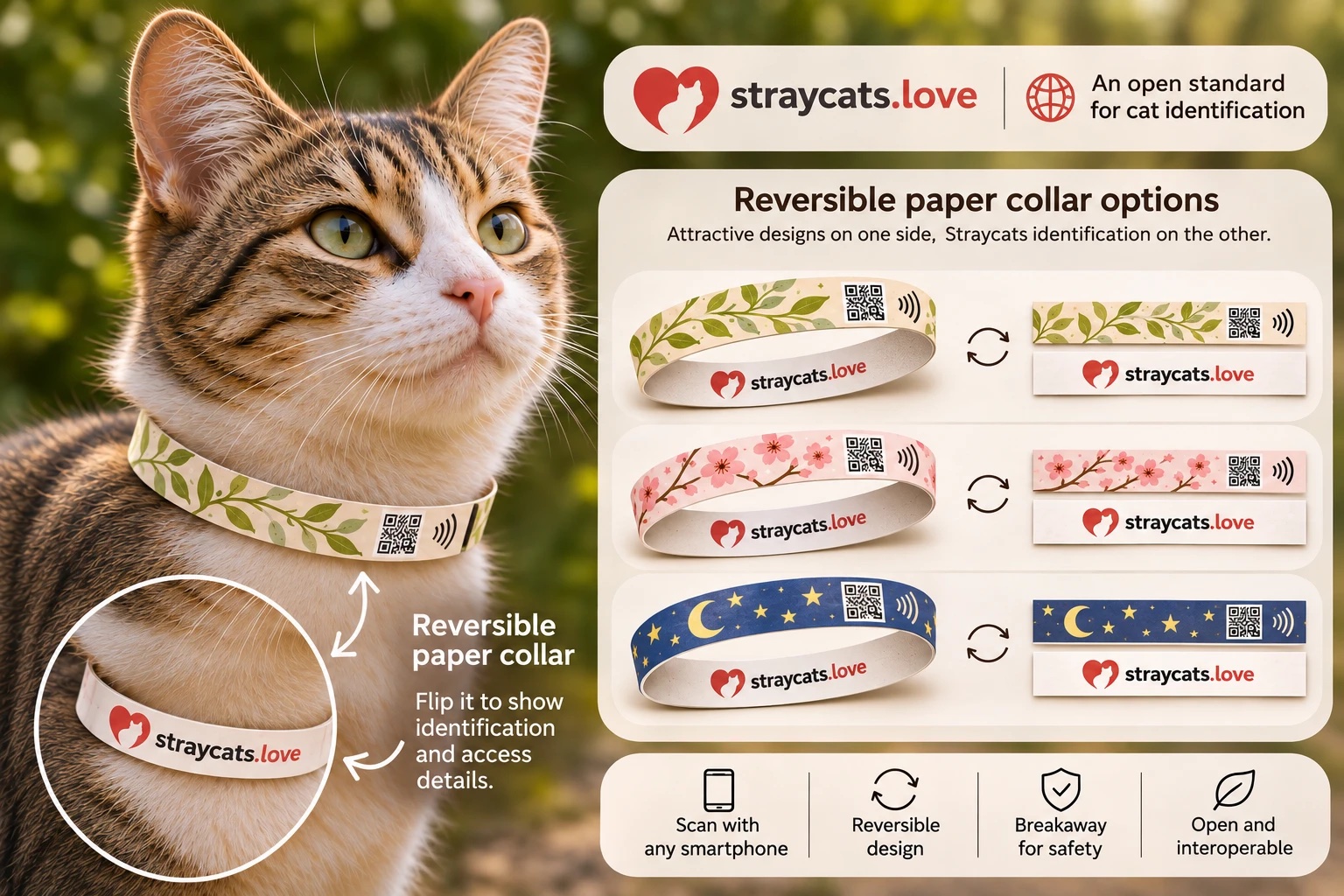
Here is how it could grow, from cheapest to most ambitious:
- A free printable template. Print it at home, cut it out, write on it. Not built yet.
- Copies for veterinary clinics, shelters and community cat groups to hand out, ideally alongside a free microchip scan. This costs almost nothing.
- Ready-made sheets. Pre-printed strips that tear off cleanly. Perforated means a line of small holes to tear along; die-cut means cut through in a custom shape; scored means creased. Ideally the material would shrug off rain but still tear easily. Tyvek wristbands are the closest ready-made product I found, but Tyvek is built to resist tearing, which is the opposite of what a breakaway collar needs, so I wouldn’t use it. Thin paper, or a water-resistant stock that tears with a light pull, would need testing. Custom print runs usually need minimums of a few hundred, and I haven’t confirmed prices.
- Packs by mail. Perhaps drop-shipped by a printing company, in different designs, with plenty of replacements for cats that keep losing their collars. I don’t know whether print-on-demand services offer perforated strips. That needs quotes, so treat it as “could one day”, after the free template and the vet copies.
The closure matters too: a slot-and-tab, or a loop through a slit, so there is no tape on fur. It should be deliberately weak, so it tears if the cat gets caught. In other words, a breakaway design.
Safety comes first
A paper collar is a small intervention on a living animal. These precautions seem sensible:
- Only for friendly cats who are comfortable being handled. Never a nervous or feral cat.
- Thin paper, not card, so it tears if snagged.
- Don’t cover the whole strip in tape. Leave part untaped so it can tear. Some guides tape over the writing to protect it from rain; a water-resistant material seems safer to me.
- Loose fit: about two fingers should slide under it, and looser is safer.
- No tape directly against fur.
- Not for kittens. This is a reasonable precaution of mine, not something I’ve seen sourced.
- Check on the cat, and take the collar off if it bothers them.
- How long to leave it on varies a lot between guides, from hours to a week or two. I won’t invent a number.
If nobody responds
Ask a vet or shelter to scan the whole body for a microchip. Chips can migrate, and a chip may be registered with a different database than the first one tried. Here is how to scan a cat for a microchip. Then ask local groups.
Many apparent strays are owned. Do these checks before removing a cat from where it lives. A collar suggests a home, but whose? As in Stray, Pet, or Somewhere in Between?, ownership is a claim, not a fact. See also When a Cat Goes Missing and Make Help Easier to Find Than Dumping.
No hard evidence yet
I haven’t found studies showing paper collars work. The reports are anecdotal. It is cheap and kind-hearted, and it might help, but I wouldn’t promise more than that.
Open questions
- What should the finder write on the strip: a phone number, a first name, or something else?
- Who prints them, and who pays?
- Is a tear-off sheet realistic, and at what cost?
- How do we keep it from being used on cats that shouldn’t be handled?
- Would vets actually hand them out?
The goal is simple: help the person who finds a cat and the person who lost one find each other, without putting the cat at risk.