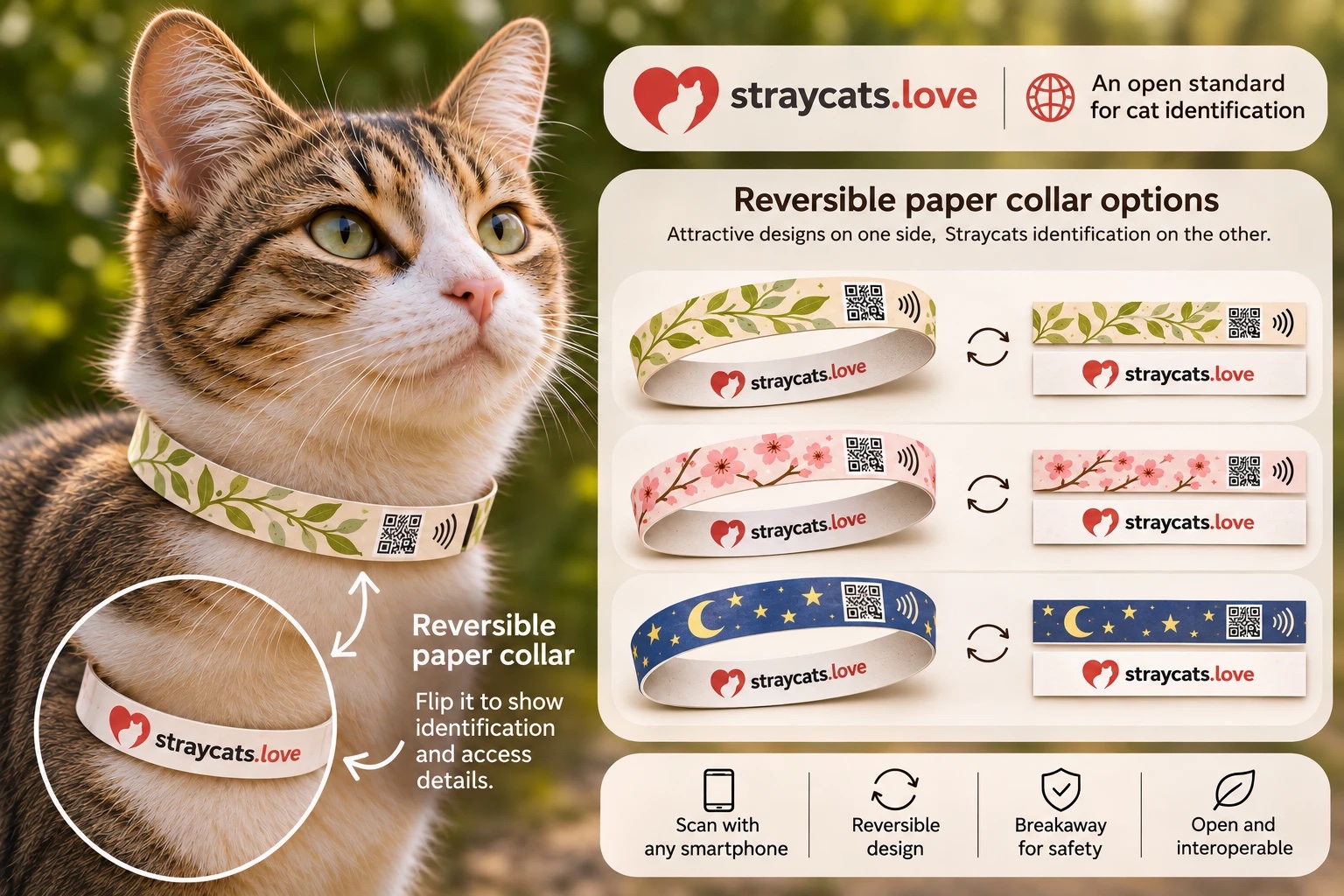
An idea for a global, open standard for cat identification.
Millions of cats live among us. Some are beloved pets, some are strays, and many are cared for by several people who may not even know one another.
When someone finds a cat, identifying it isn’t always easy.
Microchips help, but they generally require a special scanner. Collars and identification tags are easier to recognize, but they can fall off, become damaged, or contain outdated contact information.
What if we created an open global standard for cat identification that anyone could use?
The idea
Imagine a simple, inexpensive, breakaway cat collar containing a tiny NFC chip and a printed QR code.
Anyone with a smartphone could scan the collar and access information about the cat without installing an app.
Depending on what caregivers choose to share, that information might include:
- The cat’s name, photograph, and identifying features.
- Whether the cat has a home or lives in the community.
- Important medical information.
- How to contact its owner or caregivers.
- How to report a sighting or a concern.
And here’s an interesting possibility: even if the collar falls off, someone finding it could scan it and help return it to the cat’s caregiver.
An open standard, not another proprietary product
The goal wouldn’t be for Straycats to become a collar manufacturer.
Instead, we could establish an openly documented identification standard that any manufacturer could adopt.
Different companies could produce collars, tags, and other identification products at different price points, all compatible with the same underlying system.
The identification would remain useful regardless of which company manufactured the collar.
And because the standard would be open, shelters, veterinarians, rescue organizations, and independent developers could build compatible services.
What about existing microchips?
Implanted microchips are already an established identification technology, and there’s no reason to replace them.
Instead, we could explore connecting existing microchip identifiers to the same cat record.
A veterinarian using a compatible microchip scanner and a neighbor using a smartphone to scan a collar could potentially access the same identity through different methods, subject to appropriate privacy and access controls.
The important thing is the cat’s identity, not the device used to identify it.
One cat, many caregivers
This idea becomes especially interesting for community cats.
A cat might be known by several names, fed by several households, and occasionally treated by different veterinarians.
Nobody necessarily owns the cat, yet several people care deeply about its welfare.
Straycats could help bring those relationships together without requiring someone to claim ownership.
A scan could become the beginning of a connection between people who already care for the same animal.
Privacy and safety matter
An identification system should never automatically expose someone’s phone number, home address, or a cat’s sensitive location information.
Caregivers should control what information is public and how strangers can contact them.
The physical collar should carry an identifier, not private personal information.
And because cat collars can become caught on objects, any design would need to prioritize appropriate breakaway safety mechanisms.
Could this become a global standard?
That’s the bigger question.
The technology already exists. NFC chips are inexpensive, QR codes are virtually free to produce, and smartphones are widely available.
The harder challenge is interoperability - creating an open specification, trustworthy identity records, responsible governance, and a system that remains useful even if individual businesses disappear.
Perhaps Straycats could help bring manufacturers, software developers, animal welfare organizations, and caregivers together around that goal.
What do you think?
This is an early idea, not a finished specification.
I’d particularly love to hear from people working in animal identification, veterinary medicine, NFC technology, manufacturing, and animal rescue.
Are there existing standards we should build upon? What problems haven’t we considered? And what would make an open identification system genuinely useful for cats and the people who care for them?
The goal is simple: make it easier for every cat to be recognized, cared for, and connected to the people looking out for it.